Contents
What is Hydrophobicity?
Hydrophobicity (from Greek: hydro = water, phobos = fear) describes the tendency of nonpolar molecules or molecular regions to avoid contact with water and instead associate with other nonpolar entities, including lipid membranes.
The Hydrophobic Effect
The hydrophobic effect is fundamentally entropy-driven, not "water-hating." When nonpolar molecules dissolve in water, water molecules must form ordered cage-like structures (clathrates) around them, which decreases entropy. By clustering together, hydrophobic molecules minimize the ordered water surface, increasing overall system entropy.
Many ordered water cages
Low entropy ΔS < 0
Fewer ordered water cages
High entropy ΔS > 0
Thermodynamics:
ΔG = ΔH - TΔS
For the hydrophobic effect: ΔH ≈ 0, but TΔS > 0 (favorable entropy increase)
Therefore: ΔG < 0 (spontaneous clustering)
Hydropathy Scales: Quantifying Hydrophobicity
Several scales have been developed to assign numerical hydrophobicity values to amino acids. Each scale is based on different experimental approaches:
Kyte-Doolittle Scale
Method: Based on vapor-phase transfer and protein structure analysis
Range: -4.5 (Arg, most hydrophilic) to +4.5 (Ile, most hydrophobic)
Use: Predicting transmembrane regions in proteins
Published: 1982
Eisenberg Scale
Method: Normalized consensus from multiple hydrophobicity scales
Range: -1.0 to +1.0 (normalized)
Use: Helical wheel projections, amphipathicity analysis
Published: 1984
Wimley-White Scale ⭐
Method: Experimental water→membrane transfer free energy (ΔG)
Range: -1.0 to +3.0 kcal/mol
Use: Most accurate for membrane insertion predictions
Published: 1996
Why PepDraw uses it: Direct thermodynamic measurement, most biologically relevant
Interpreting ΔG Values (Wimley-White)
The Wimley-White scale reports the free energy change (ΔG) for transferring an amino acid from water into a lipid bilayer interface, measured in kcal/mol:
Very hydrophilic
Strongly resists membrane insertion
Examples: Arg (+2.5), Lys (+2.8), Asp (+3.6)
Neutral / Ambivalent
No preference for water or membrane
Examples: Gly (-0.01), Thr (0.14), Ser (0.13)
Very hydrophobic
Strongly favors membrane insertion
Examples: Phe (-1.71), Leu (-2.28), Ile (-1.12)
For peptides: Sum the ΔG values for all residues. More negative = more hydrophobic = greater tendency to partition into membranes.
Measuring Hydrophobicity
Hydrophobicity can be measured experimentally or calculated from sequence. Each method provides different but complementary information.
Experimental Methods
1. Partition Coefficient (octanol/water)
Principle: Measure the distribution of a peptide between water and octanol (a nonpolar solvent that mimics membrane interior).
log P > 0: Hydrophobic (prefers octanol)
log P < 0: Hydrophilic (prefers water)
Advantages: Direct thermodynamic measurement
Limitations: Octanol ≠ real membrane (lacks charge, different structure)
2. Retention in Reverse-Phase HPLC
Principle: Hydrophobic peptides bind more strongly to the nonpolar stationary phase and elute later (longer retention time).
Advantages: Easy, fast, reproducible, correlates well with membrane affinity
Use: Predict membrane-binding peptides, optimize synthesis
3. Transfer Free Energy (Wimley-White Method)
Principle: Directly measure the energy required to move peptide from water into lipid vesicles using equilibrium dialysis or isothermal titration calorimetry (ITC).
Advantages: Most biologically relevant, accounts for real membrane properties
Gold standard: This is how Wimley-White scale was derived
Calculated vs Experimental Hydrophobicity
Calculated hydrophobicity (summing per-residue values) assumes:
- Additivity: Each residue contributes independently (not always true!)
- No context effects: Ignores neighboring residues and 3D structure
- Linear peptides: Doesn't account for folding, cyclic structures, or disulfides
- No charge effects: Actual insertion depends heavily on membrane charge and pH
Reality: Calculated values are useful estimates but can differ significantly from experimental measurements. For critical applications, validate experimentally!
The Amphipathic Helix
An amphipathic helix (also called amphiphilic helix) is an α-helix with distinct hydrophobic and hydrophilic faces. This structural motif is crucial for membrane interactions and protein function.
Structure and Properties
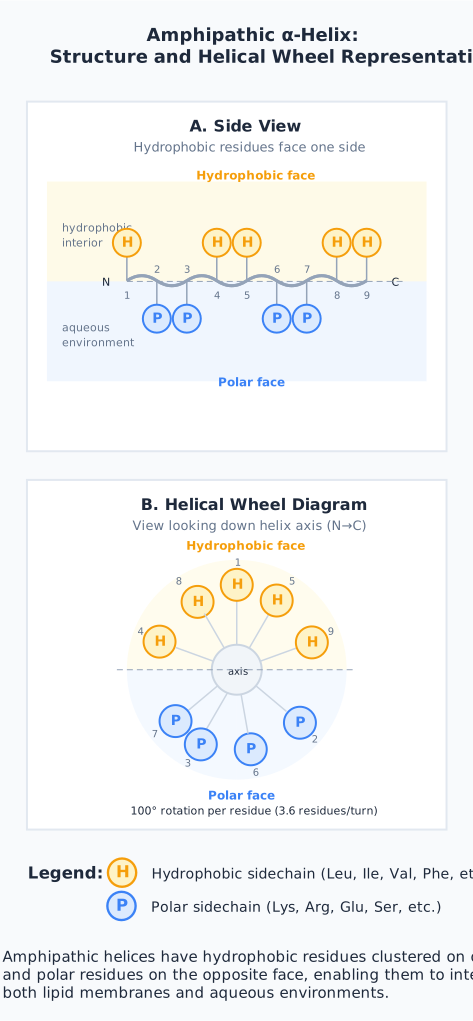
Key Features:
- Periodicity: α-helix has 3.6 residues per turn
- i, i+3, i+4 pattern: Residues ~100° apart face same direction
- Segregation: Hydrophobic residues cluster on one face, polar on other
- Stability: Amphipathic helices are stable at membrane interfaces
Helical Wheel Projections
A helical wheel is a 2D projection looking down the helix axis, showing which residues face which direction. This visualization reveals amphipathicity:
How to Read a Helical Wheel
- Each residue is plotted at 100° intervals (360°/3.6 residues)
- Residue 1 at top (12 o'clock)
- Residue 2 at ~100° clockwise
- Residue 3 at ~200° clockwise
- Residue 4 nearly below residue 1 (~300°)
- Color-code by property: blue (hydrophobic), red (charged), green (polar)
Identifying Amphipathicity
- Perfect amphipathic: Clear separation into two hemispheres
- Partial amphipathic: Some segregation but not perfect
- Non-amphipathic: Random distribution of properties
- Hydrophobic moment (μH): Vector sum quantifies amphipathicity
Importance in Biology
Melittin: A Case Study
Melittin is the principal toxic component of bee venom and serves as the archetypal amphipathic, membrane-disrupting peptide. Its well-studied properties make it an ideal teaching example.
Structural Properties
Primary Structure
- N-terminal (1-20): Predominantly hydrophobic
- C-terminal (21-26): Highly cationic (2 Lys + 2 Arg)
- Proline at position 14: Creates kink in helix
- No disulfide bonds: Linear peptide
- C-terminus amidated: –CONH₂ (natural modification)
Secondary Structure
- In water: Mostly random coil (unstructured)
- At membranes: Adopts α-helical conformation
- Bent helix: Residues 1-10 and 13-26 (bent at Pro14)
- Amphipathic: Strong segregation of hydrophobic/hydrophilic faces
- Membrane-induced folding: Structure forms upon lipid binding
Charge Distribution
- Positive charges: 6 total (4 Lys + 2 Arg)
- Net charge: Strongly positive at physiological pH
- Electrostatic attraction: Binds negatively charged membranes
- pI = 12.1: Positive at all biological pH values
Hydrophobicity
- Wimley-White ΔG:
Residues 1-20: ~ -4 kcal/mol (hydrophobic overall)
Residues 21-26: ~ +11 kcal/mol (very hydrophilic overall) - Hydrophobic moment: μH = 0.52 (high amphipathicity)
- HPLC retention: Long retention time in RP-HPLC
- Membrane affinity: Partitions strongly into lipid bilayers
- Critical for activity: Hydrophobic residues drive insertion
Mechanism of Action
Step-by-Step Membrane Disruption
Positively charged melittin (+7 at pH 7.4) is attracted to negatively charged lipid headgroups (phosphatidylserine, phosphatidylglycerol in bacterial membranes).
Melittin binds parallel to membrane surface (S-state). The amphipathic helix aligns with hydrophobic face toward lipids, charged face toward water/headgroups.
At critical concentration, melittin reorients perpendicular to membrane (I-state for "inserted"). Multiple helices oligomerize to form transmembrane pores.
4-6 melittin monomers form a toroidal pore (~3-4 nm diameter). Lipid headgroups line the pore interior, with melittin helices embedded in the lipid-water interface.
Pores allow uncontrolled ion flux, dissipating membrane potential and osmotic balance. Water influx causes cell swelling and eventual lysis (cell death).
Why Melittin is Cytotoxic
Melittin disrupts all biological membranes, not just bacterial:
- Hemolysis: Lyses red blood cells at low concentrations (µM)
- Cytotoxicity: Kills mammalian cells (not selective for bacteria)
- Inflammatory: Activates phospholipase A₂, releases inflammatory mediators
- Pain: Main component of bee sting pain (activates nociceptors)
Why bacterial selectivity matters: Ideal antimicrobial peptides should kill bacteria but spare mammalian cells. Melittin lacks this selectivity, limiting therapeutic use despite potent antimicrobial activity.
Improving selectivity: Researchers modify melittin's sequence to increase bacterial selectivity by tuning charge, hydrophobicity, and amphipathicity.
Applications Despite Toxicity
Melittin encapsulated in nanoparticles targets tumor cells, reducing systemic toxicity. Shown efficacy against melanoma, breast cancer, and leukemia in preclinical studies.
Model peptide for studying membrane interactions, pore formation, and amphipathic helix folding. Extensively characterized structurally (NMR, X-ray, MD simulations).
Potential for wound dressings or skin infections where systemic absorption is minimal. Active against MRSA and other resistant bacteria.
Low concentrations modulate immune responses. Being investigated for autoimmune diseases and HIV therapy (disrupts viral envelope).
Cell-Penetrating Peptides (CPPs)
Cell-penetrating peptides (CPPs), also called protein transduction domains (PTDs), are short sequences (typically 5-30 amino acids) that can cross cell membranes and deliver cargo into cells.
What Makes Peptides Cell-Penetrating?
1. Positive Charge
Required range: Net charge +6 to +10 at pH 7.4
Why: Interact with negatively charged membrane components
(phospholipid headgroups, glycosaminoglycans)
Key residues: Arginine > Lysine (guanidinium forms better H-bonds)
2. Amphipathic Character
Balance needed: Some hydrophobicity for membrane insertion
Ideal: Amphipathic α-helix upon membrane binding
Avoid: Too hydrophobic (aggregates), too hydrophilic (won't insert)
3. Moderate Length
Sweet spot: 10-20 amino acids
Too short (<8): Insufficient membrane interactions
Too long (>30): May adopt stable structure that hinders uptake
4. Sequence Flexibility
Preferred: Lack of rigid secondary structure in solution
Why: Allows conformational adaptation to membrane environment
Avoid: Strong β-sheet formers (aggregation risk)
Mechanisms of Cell Penetration
CPPs can enter cells through multiple pathways, often simultaneously:
Direct Penetration
Process: CPP inserts directly through membrane without endocytosis
Requirements: High peptide concentration, specific lipid composition
Advantages: Rapid, no endosomal entrapment
Mechanism: Possibly via transient pores or membrane destabilization
Endocytosis
Process: Membrane invagination forms vesicles that bring CPP inside
Types: Clathrin-mediated, caveolin-mediated, macropinocytosis
Challenge: Must escape endosome to reach cytoplasm (endosomal escape)
Strategies: pH-sensitive sequences, fusogenic peptides
Classic CPP Examples
TAT Peptide
Origin: HIV TAT protein (residues 47-57)
Charge: +8 (6 Arg, 2 Lys)
Mechanism: Primarily endocytosis, some direct penetration
Use: Most widely studied CPP, delivers proteins, DNA, drugs
Note: Works across diverse cell types
Penetratin (Antennapedia)
Origin: Drosophila Antennapedia homeodomain (residues 43-58)
Charge: +7
Structure: Amphipathic α-helix
Mechanism: Inverted micelle formation suggested
Use: Delivers peptide nucleic acids (PNAs), siRNA
Polyarginine (R9)
Design: Synthetic, all-arginine sequence
Charge: +9
Advantage: Simple, easy to synthesize, highly efficient
Mechanism: Primarily endocytosis via interaction with proteoglycans
Note: Arginine > lysine for cell penetration
Transportan
Design: Chimera of galanin and mastoparan
Charge: +6
Structure: Amphipathic helix
Mechanism: Both direct penetration and endocytosis
Special: Also antimicrobial (non-selective membrane disruption)
CPP Applications in Drug Delivery
The ideal CPP strikes a balance:
- Too hydrophilic: Won't insert into membrane (stays in solution)
- Too hydrophobic: Aggregates in solution, cytotoxic, non-specific binding
- Optimal: Amphipathic character allows membrane interaction while maintaining solubility
Rule of thumb: Net charge +6 to +10, include 2-4 hydrophobic residues (Trp, Phe, Leu) distributed to create amphipathicity, avoid large hydrophobic patches.
Antimicrobial Peptides (AMPs)
Antimicrobial peptides are part of innate immunity across all domains of life. These host defense peptides provide rapid, broad-spectrum protection against bacteria, fungi, and viruses.
What Makes AMPs Selective for Bacteria?
Key Difference: Membrane Composition
- Outer leaflet: Rich in anionic lipids (phosphatidylglycerol, cardiolipin)
- Net charge: Strongly negative
- Consequence: Attracts cationic AMPs via electrostatics
- Outer leaflet: Zwitterionic lipids (phosphatidylcholine, sphingomyelin)
- Net charge: Nearly neutral
- Consequence: Weaker attraction to cationic AMPs
- Additional protection: Cholesterol stabilizes membrane
Selectivity mechanism: Cationic AMPs preferentially bind to anionic bacterial membranes. At appropriate concentrations, they kill bacteria while sparing host cells.
AMP Families
Defensins
Structure: 3-4 disulfide bonds forming stable β-sheet structure
Size: 18-45 amino acids
Charge: +4 to +8
Examples: Human α-defensins (HD-5, HD-6), β-defensins (HBD-1, HBD-2)
Location: Neutrophils, epithelial surfaces, Paneth cells
Mechanism: Pore formation, membrane permeabilization
Cathelicidins
Structure: α-helical in membrane-bound form
Size: 12-80 amino acids
Example: LL-37 (human), only human cathelicidin
Sequence (LL-37): LLGDFFRKSKEKIGKEFKRIVQRIKDFLRNLVPRTES
Charge: +6
Special: Also immunomodulatory (chemotaxis, wound healing)
Magainins
Origin: African clawed frog (Xenopus laevis) skin
Structure: Amphipathic α-helix
Size: 23 amino acids
Charge: +3 to +5
Example: Magainin 2
Activity: Broad-spectrum, low toxicity to mammalian cells
Note: Inspiration for pexiganan (synthetic derivative, clinical trials)
Cecropins
Origin: Insect hemolymph
Structure: Two amphipathic helices connected by hinge
Size: 31-39 amino acids
Charge: +5 to +8
Mechanism: Carpet model (detergent-like disruption)
Special: Active against Gram-negative bacteria
Common Structural Features of AMPs
- Cationic: Net positive charge (+2 to +9) for electrostatic attraction
- Amphipathic: ~50% hydrophobic residues for membrane insertion
- Short: 12-50 amino acids (easy to synthesize, less immunogenic)
- α-helical or β-sheet: Structured at membranes, often unstructured in solution
- Arg/Lys rich: Basic residues for charge and membrane interaction
Beyond Bacteria: Broad Antimicrobial Activity
Membrane Disruption Mechanisms
AMPs and membrane-active peptides disrupt bilayers through several distinct mechanisms. Understanding these helps design peptides with desired selectivity and potency.
1. Barrel-Stave Model
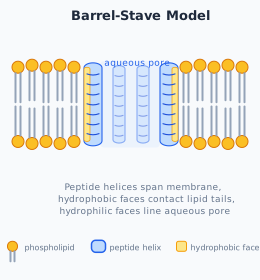
Process: Peptides insert perpendicular to membrane, forming transmembrane pore with hydrophobic faces toward lipids, hydrophilic faces lining pore interior.
Requirements: Long peptides (20-30 aa), high hydrophobic moment, stable helices
Examples: Alamethicin, some synthetic peptides
2. Toroidal (Wormhole) Pore
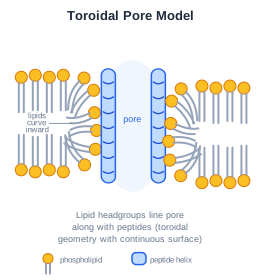
Process: Peptides induce membrane curvature, lipid headgroups line pore along with peptides (toroidal geometry).
Difference from barrel-stave: Lipids participate in pore structure (not just peptides)
Examples: Melittin, magainin, protegrin
3. Carpet Model
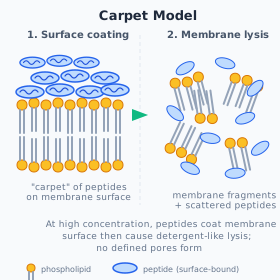
Process: Peptides accumulate parallel to membrane surface at high concentration, acting like detergent. Membrane disintegrates into micelles.
No defined pores: General membrane disruption/solubilization
Examples: Cecropins, dermcidin, some short AMPs
4. Detergent-Like Disruption
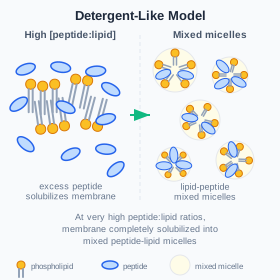
Process: At very high peptide:lipid ratios, membrane is completely solubilized into mixed peptide-lipid micelles.
Characteristic: Threshold concentration needed, rapid disruption
Examples: Highly amphipathic short peptides, extreme conditions
Which Mechanism When?
- Peptide concentration: Low = pores, high = carpet/detergent
- Peptide length: Long = barrel-stave, short = carpet
- Amphipathicity: High μH = toroidal pores, moderate = carpet
- Membrane composition: Anionic lipids favor pore formation
- Peptide structure: Rigid helices = barrel-stave, flexible = toroidal/carpet
Important: A single peptide may use different mechanisms depending on conditions! For example, melittin uses toroidal pores at low concentration but carpet model at high concentration.
Membrane Binding vs Penetration
Not all membrane-interactive peptides penetrate fully. Understanding the difference helps design peptides for specific functions.
Surface Binding (Peripheral)
Location: Peptide remains at membrane-water interface
Orientation: Usually parallel to membrane surface
Depth: Shallow (~5-10 Å from surface)
Driving force: Electrostatic attraction + shallow hydrophobic insertion
Typical properties:
• High charge, moderate hydrophobicity
• Amphipathic helix
• Charge > hydrophobicity
Examples: Initial binding of melittin, many AMP intermediates
Transmembrane Insertion (Integral)
Location: Peptide spans membrane
Orientation: Perpendicular to membrane surface
Depth: Full bilayer thickness (~30-40 Å)
Driving force: Hydrophobic effect dominates
Typical properties:
• High hydrophobicity
• Sufficient length to span bilayer (≥18-20 aa as helix)
• Hydrophobicity > charge
Examples: Transmembrane domains of receptors, melittin pores, alamethicin
Depth of Insertion
The extent of membrane penetration depends on peptide properties:
Headgroup region
0-5 Å depth
Very hydrophilic peptides
Glycerol backbone
5-15 Å depth
Amphipathic peptides
Hydrocarbon core
15-25 Å depth
Hydrophobic peptides
Spans bilayer
~30-40 Å
Very hydrophobic, long peptides
- Fluorescence quenching: Depth-dependent quenching by brominated lipids
- Solid-state NMR: Orientation and depth from ³¹P, ²H NMR
- EPR spectroscopy: Spin-labeled lipids at different depths
- X-ray/neutron diffraction: Electron density profiles show peptide location
- MD simulations: Computational prediction of insertion depth
Designing Membrane-Active Peptides
Rational design of membrane-active peptides requires balancing multiple properties. Here are evidence-based guidelines for different applications.
Design Principles by Application
For Cell-Penetrating Peptides (CPPs)
- Net charge: +6 to +10
- Prefer Arg over Lys (guanidinium H-bonding)
- Distribute charges evenly (avoid clustering)
- Include 20-40% hydrophobic residues
- Prefer Trp, Phe (aromatic stacking with membrane)
- Avoid large hydrophobic patches (aggregation)
- Optimal: 10-20 amino acids
- Too short (<8): Inefficient
- Too long (>30): May fold, reducing flexibility
- Flexible in solution, folds at membrane
- Avoid strong β-sheet formers
- Amphipathic helix ideal
For Selective Antimicrobial Peptides
- Net charge: +2 to +6 (optimal +4)
- Too high charge: Binds mammalian cells too
- Include hydrophobic residues: 40-60%
- Hydrophobic moment μH: 0.4-0.6
- Clear segregation of faces
- Use helical wheel to verify
- Keep total hydrophobicity moderate
- Avoid very long (>30 aa) sequences
- Test against RBCs early in development
- Alternate charged/hydrophobic (e.g., KLKLKLKL)
- Or block design with distinct regions
- Include helix-stabilizing residues (Ala, Leu)
For Membrane-Disrupting Peptides
- Charge: +6 to +8
- Hydrophobicity: 50-70%
- Strong amphipathicity (μH > 0.5)
- Length: 20-30 aa for pore formation
- α-helical at membranes
- Unstructured in solution (membrane-induced folding)
- Flexible hinge regions allowed (e.g., Pro, Gly)
- High potency = high toxicity
- Limit systemic use
- Consider nanoparticle encapsulation
For Membrane Anchors/Targeting
- High hydrophobicity (ΔG < -10 kcal/mol)
- Length: ≥20 aa to span bilayer if transmembrane
- Or 10-15 aa for peripheral anchors
- Mostly hydrophobic (Leu, Ile, Val, Ala)
- α-helical (stable in membrane)
- Minimal charged residues in core
- Flanking charged residues (stop transfer)
- Amphipathic helix
- Hydrophobic face inserts, polar face exposed
- Examples: Lipid-binding domains, ApoA-I
Common Design Mistakes to Avoid
Solution: Include polar residues, limit hydrophobic patches, use spacers
Solution: Add hydrophobic residues (Trp, Phe, Leu) for amphipathicity
Solution: Design with helical wheel, ensure segregation of properties
Solution: Start with 15-20 aa, optimize based on activity
Interactive Tools
Use these calculators to evaluate peptide hydrophobicity and amphipathicity:
💧 Calculator 1: Wimley-White Hydrophobicity
Calculate transfer free energy (ΔG) from water to membrane interface:
⚖️ Calculator 2: Amphipathicity Analyzer
Analyze hydrophobic/hydrophilic distribution and calculate hydrophobic moment: