Contents
What Are Amino Acids?
Amino acids are the fundamental building blocks of proteins and peptides. Every amino acid shares a common core structure but differs in its side chain (R group), which determines its unique chemical and physical properties.
The General Structure
        NH₃⁺
        |
    R — Cα — COO⁻
        |
        H
Four Groups Around the Central α-Carbon:
- Amino group (–NH₃⁺): Always attached to the α-carbon (hence "α-amino acid")
- Carboxyl group (–COO⁻): Provides the acidic character
- Hydrogen atom (–H): The fourth substituent (except in glycine)
- Side chain (R): Variable group that defines each amino acid's identity
Zwitterionic Nature
At physiological pH (~7.4), amino acids exist as zwitterions—molecules that carry both a positive charge (on the amino group) and a negative charge (on the carboxyl group) simultaneously:
This dipolar form is the predominant species in aqueous solution at neutral pH. The amino acid has zero net charge (charge balance) but is not uncharged—both the positive and negative charges are present and electrostatically active.
Why this matters: The zwitterionic character affects solubility, crystal packing, and reactivity. It also explains why amino acids have relatively high melting points (strong ionic interactions) compared to similar-sized uncharged molecules.
The 20 Standard Amino Acids
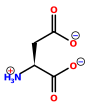
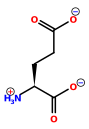
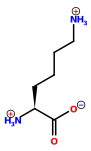
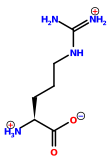
Twenty amino acids are encoded by the standard genetic code and commonly found in proteins. Each is abbreviated by both a three-letter code and a single-letter code:


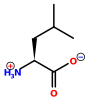
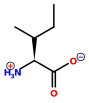
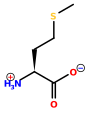
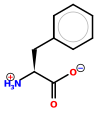
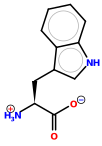


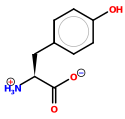
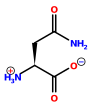
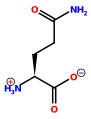
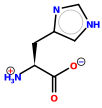
Common mnemonics for remembering amino acids:
- Nonpolar: "GAVLIM FWP" (sounds like "gave 'em FWP")
- Polar: "STCYNQ" (stick-en-cue)
- Acidic: "DE" (Aspartate, Glutamate - think "D-E-acidic")
- Basic: "KRH" (Lysine, aRginine, Histidine - think "cationic")
Amino Acid Classification
Amino acids can be classified in multiple ways based on their chemical and physical properties. The most common classification is by side chain polarity and charge.
By Side Chain Properties
🔵 Nonpolar / Hydrophobic (9 amino acids)
Members: Gly (G), Ala (A), Val (V), Leu (L), Ile (I), Met (M), Phe (F), Trp (W), Pro (P)
Characteristics:
- Side chains contain mostly carbon and hydrogen
- Cannot form hydrogen bonds with water (except backbone)
- Tend to cluster together in protein cores (hydrophobic effect)
- Critical for membrane protein structure and stability
Special cases:
• Glycine (G): Smallest side chain (R = H), achiral, provides flexibility
• Proline (P): Cyclic structure, restricts backbone flexibility, "helix breaker"
• Aromatic (F, W, Y): Contain benzene-like rings, absorb UV light at 280 nm
🟢 Polar, Uncharged (6 amino acids)
Members: Ser (S), Thr (T), Cys (C), Tyr (Y), Asn (N), Gln (Q)
Characteristics:
- Can form hydrogen bonds with water and other molecules
- Often found on protein surfaces
- Participate in enzyme active sites and binding pockets
- Neutral at physiological pH (no net charge)
Special cases:
• Cysteine (C): Thiol group (–SH) can form disulfide bonds (S–S), pKa ~8.3
• Tyrosine (Y): Phenolic –OH can be ionized at high pH, pKa ~10.1
• Serine & Threonine: Hydroxyl groups, sites for phosphorylation (PTM)
🔴 Negatively Charged / Acidic (2 amino acids)
Members: Asp (D), Glu (E)
Characteristics:
- Carboxyl groups in side chains (pKa ~3.9-4.1)
- Negatively charged (–COO⁻) at physiological pH
- Repel other negative charges, attract positive charges
- Critical for metal ion binding (Ca²⁺, Mg²⁺, Zn²⁺)
Nomenclature note: "Aspartate" and "glutamate" refer to the ionized forms (–COO⁻), while "aspartic acid" and "glutamic acid" refer to the protonated forms (–COOH). At pH 7.4, they exist almost entirely as aspartate and glutamate.
🟣 Positively Charged / Basic (3 amino acids)
Members: Lys (K), Arg (R), His (H)
Characteristics:
- Nitrogen-containing groups that can accept protons
- Positively charged at physiological pH (except His, which is ~5% protonated)
- Attract negative charges, critical for DNA/RNA binding
- Essential for cell-penetrating peptides and antimicrobial peptides
Special cases:
• Lysine (K): pKa ~10.5, almost always protonated (+) at pH 7.4
• Arginine (R): pKa ~12.5, always protonated (+) at biological pH
• Histidine (H): pKa ~6.0, can switch between protonated/deprotonated near pH 7.4
Understanding amino acid categories helps predict:
- Protein structure: Hydrophobic residues buried inside, polar residues on surface
- Enzyme mechanisms: Acidic/basic residues in active sites for catalysis
- Protein-protein interactions: Charge complementarity (opposites attract)
- Membrane association: Hydrophobic and positively charged peptides cross membranes
- Post-translational modifications: Specific residues are modification sites (Ser/Thr for phosphorylation, Lys for acetylation)
The Peptide Bond
Amino acids link together through peptide bonds to form chains. Understanding peptide bond formation, structure, and properties is essential for comprehending peptide behavior.
Formation: Condensation Reaction
The Bond-Forming Reaction
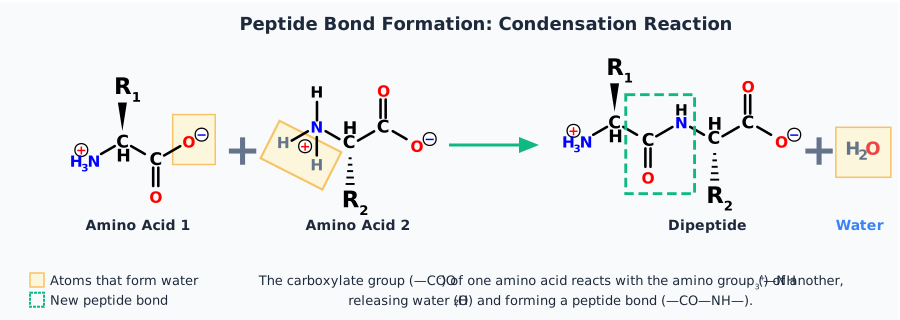
Key points:
- The carboxyl group of one amino acid reacts with the amino group of another
- A water molecule is released (hence "condensation" or "dehydration" reaction)
- The resulting C–N bond is the peptide bond (also called amide bond)
- In cells, this reaction requires energy (ATP) and ribosome machinery
- In chemical synthesis, requires activating agents and protecting groups
Breaking: Hydrolysis Reaction
The Bond-Breaking Reaction
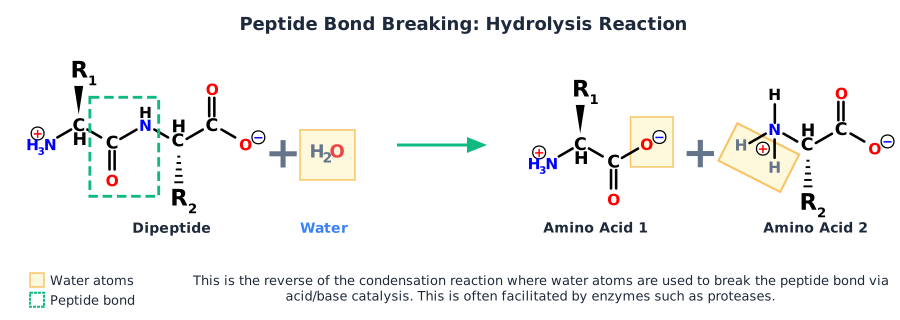
Key points:
- Water is added across the peptide bond (hence "hydrolysis")
- The peptide bond is cleaved, regenerating free amino acids
- In cells, proteases (enzymes) catalyze this reaction
- Spontaneous hydrolysis is very slow at neutral pH (half-life ~500 years!)
- Can be accelerated by acid, base, or heat
Structure and Properties of the Peptide Bond
Consequence: Restricted rotation around the C–N bond
Rotation is allowed: Around Cα–C bonds (ψ angle) and Cα–N bonds (φ angle)
Exception: Proline can adopt cis configuration (~5-10% of X-Pro bonds)
H-bond donors: N–H groups
H-bond acceptors: C=O groups
The peptide bond's partial double bond character makes it remarkably stable. This stability is essential for proteins to maintain their structure, but it also means:
- Proteins are kinetically stable even when thermodynamically unstable (metastable)
- Protein degradation requires specific proteases (enzymes) to break bonds efficiently
- Synthetic peptides can be stored for long periods without significant degradation
- Special conditions (strong acid, high temperature) are needed to hydrolyze peptides in the lab
From Amino Acids to Peptides
When amino acids link together through peptide bonds, they form peptide chains with distinct structural features and conventions.
Primary Structure: The Sequence
Peptide sequences are written from N-terminus to C-terminus (left to right), using either three-letter or one-letter amino acid codes:
Gly-Ile-Gly-Ala-Val-Leu-Lys-Val-Leu
GIGAVLKVL
H₂N-GIGAVLKVL-COOH
(showing free N-terminus and C-terminus)
Why N→C convention? This matches the direction of ribosomal synthesis (proteins are built from N-terminus to C-terminus) and is universally used in biochemistry.
N-Terminus and C-Terminus
N-Terminus
Structure: Free amino group (–NH₃⁺ at pH 7.4)
Also called: Amino terminus, N-terminal end
Charge: Usually +1 at physiological pH (pKa ~9.0)
Can be modified: Acetylation (Ac-) removes the charge
C-Terminus
Structure: Free carboxyl group (–COO⁻ at pH 7.4)
Also called: Carboxyl terminus, C-terminal end
Charge: Usually -1 at physiological pH (pKa ~3.1)
Can be modified: Amidation (–NH₂) removes the charge
Peptides vs Proteins
| Feature | Peptides | Proteins |
|---|---|---|
| Length | Typically 2-50 amino acids | Typically >50 amino acids |
| Structure | Often linear, may have some secondary structure | Complex 3D structure with defined tertiary/quaternary structure |
| Synthesis | Can be chemically synthesized (solid-phase peptide synthesis) | Usually produced by recombinant expression in cells |
| Stability | Generally stable, flexible | Require proper folding for stability and function |
| Examples | Oxytocin (9 aa), Insulin B-chain (30 aa), Melittin (26 aa) | Lysozyme (129 aa), Hemoglobin (574 aa), Titin (38,138 aa) |
Note: The boundary between "peptide" and "protein" is arbitrary and not strictly defined. Generally, chains <50 amino acids are called peptides, while longer chains are proteins. However, small proteins (like insulin at 51 residues) may still be called proteins despite their size.
Beyond simple linear peptides, several special categories exist:
- Dipeptides: Two amino acids (e.g., Ala-Gly)
- Tripeptides: Three amino acids (e.g., glutathione: Glu-Cys-Gly)
- Oligopeptides: 3-20 amino acids
- Polypeptides: Many amino acids (>20), often synonymous with "protein"
- Cyclic peptides: N- and C-termini are bonded (head-to-tail cyclization)
- Stapled peptides: Chemically crosslinked within the sequence for stability
Peptide Properties Overview
Several key properties can be calculated or predicted from a peptide's amino acid sequence. These properties are essential for understanding peptide behavior and designing experiments.
Molecular Weight
What it is: The sum of atomic masses of all atoms in the peptide.
How to calculate: Add the mass of each amino acid residue (amino acid minus H₂O) plus terminal groups (H for N-term, OH for C-term).
Why it matters: Essential for mass spectrometry, concentration calculations, and gel electrophoresis (SDS-PAGE).
Units: Daltons (Da) or g/mol
Net Charge
What it is: The algebraic sum of all positive and negative charges at a given pH.
How to calculate: Count charged groups (N-term, C-term, K, R, H, D, E) and apply Henderson-Hasselbalch equation for each based on pH and pKa.
Why it matters: Determines electrostatic interactions, membrane binding, and purification strategy (ion exchange chromatography).
Isoelectric Point (pI)
What it is: The pH at which the peptide has zero net charge (zwitterion).
How to calculate: Find the pH where positive charges = negative charges using iterative numerical methods (bisection, Newton-Raphson).
Why it matters: Minimum solubility at pI, maximum aggregation at pI, critical for isoelectric focusing (IEF) and formulation.
Hydrophobicity
What it is: A measure of how "water-fearing" vs "water-loving" the peptide is.
How to calculate: Sum hydrophobicity values for each amino acid using scales like Wimley-White (based on water→membrane transfer free energy).
Why it matters: Predicts membrane interactions, retention in reverse-phase HPLC, and tendency to aggregate. Essential for cell-penetrating peptides.
Units: ΔG (kcal/mol)
Extinction Coefficient (ε₂₈₀)
What it is: How strongly the peptide absorbs UV light at 280 nm wavelength.
How to calculate: Count aromatic residues: Trp (5,500) + Tyr (1,490) + Cys-Cys disulfides (125).
Why it matters: Allows accurate concentration measurement using UV-Vis spectroscopy via Beer-Lambert law (A = εcl).
Units: M⁻¹cm⁻¹
Chemical Formula
What it is: The count of each element (C, H, N, O, S) in the peptide.
How to calculate: Sum the elemental composition of each amino acid residue plus terminal groups (H and OH).
Why it matters: Needed for accurate mass calculations, isotope labeling experiments, and elemental analysis.
Example: Gly-Ala = C₅H₁₀N₂O₃
PepDraw automatically calculates all these properties from your peptide sequence. Simply enter your sequence in the app, and instantly see:
- Molecular weight (exact mass)
- Net charge at any pH (interactive slider)
- Isoelectric point (pI)
- Hydrophobicity (Wimley-White ΔG)
- Extinction coefficient (ε₂₈₀)
- Chemical formula (C, H, N, O, S counts)
- Plus: Full chemical structure visualization!
Stereochemistry in Detail
With the exception of glycine (which has R = H), all amino acids have a chiral center at the α-carbon, meaning they can exist as two non-superimposable mirror images (enantiomers).
L vs D Amino Acids
L-Amino Acids (Natural)
- All 20 standard amino acids are L-amino acids
- The amino group is on the LEFT in Fischer projection
- Used by ribosomes to make proteins
- Corresponds to (S) configuration in R/S nomenclature (except Cys)
             COO⁻
             |
        H₃N⁺—C—H
             |
             R

    (L-amino acid)
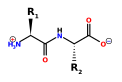
How L-amino acids are rendered in PepDraw (up and down):
D-Amino Acids (Synthetic/Rare Natural)
- Mirror images of L-amino acids
- The amino group is on the RIGHT in Fischer projection
- Found in bacterial cell walls and some natural antibiotics
- Used in synthetic peptides for protease resistance
            COO⁻
            |
          H—C—NH₃⁺
            |
            R

        (D-amino acid)
How D-amino acids are rendered in PepDraw (up and down):
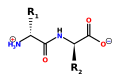
Why Does Stereochemistry Matter?
There are two systems for naming stereochemistry:
- L/D system: Based on Fischer projections, compares to glyceraldehyde. Biochemists use this for amino acids.
- R/S system (Cahn-Ingold-Prelog): Based on priority rules for substituents. Chemists use this universally.
Important: Most L-amino acids are (S), but L-cysteine is (R) because the sulfur in the side chain has higher priority than the carboxyl group! Don't assume L = S.
Side Chain Properties
The 20 standard amino acids differ only in their side chains (R groups), yet these variations create enormous functional diversity. Understanding side chain properties is key to predicting peptide behavior.
Key Side Chain Features
Size and Shape
Side chains range from the smallest (Gly, R = H) to large bulky groups (Trp, with an indole ring).
- Small: Gly, Ala, Ser (allow tight packing)
- Medium: Val, Thr, Cys, Pro
- Large: Phe, Tyr, Trp, Arg (create steric constraints)
Functional impact: Small residues (Gly) provide flexibility; large residues restrict conformations and drive specific folding patterns.
Polarity and Charge
This is the most common classification scheme (covered in detail above). Briefly:
- Nonpolar: Cannot H-bond, cluster in hydrophobic cores
- Polar uncharged: Can H-bond, often on protein surfaces
- Charged (acidic/basic): Drive electrostatic interactions
Hydrogen Bonding Capability
Several side chains can donate or accept hydrogen bonds:
- H-bond donors: Ser, Thr, Cys, Tyr (–OH groups), Asn, Gln, Trp (–NH groups)
- H-bond acceptors: Asp, Glu (–COO⁻), Asn, Gln (C=O), Ser, Thr, Tyr (–O⁻ at high pH)
- Both: His (imidazole can donate and accept)
Functional impact: H-bonding stabilizes secondary structure, mediates protein-protein interactions, and is critical in enzyme active sites.
Special Functional Groups
Some amino acids have unique reactive groups:
Thiol (Cys)
• Can form disulfide bonds (Cys-S-S-Cys)
• Nucleophilic at high pH (thiolate, –S⁻)
• Redox active (oxidation ↔ reduction)
• pKa ~8.3, partially deprotonated at pH 7.4
Phenol (Tyr)
• Weakly acidic (pKa ~10.1)
• Can be phosphorylated (PTM)
• Absorbs UV light (280 nm)
• Neutral at physiological pH
Imidazole (His)
• pKa ~6.0 (near physiological pH!)
• Acts as both acid and base
• pH sensor in proteins
• Essential in many enzyme active sites
Indole (Trp)
• Largest standard side chain
• Strongly absorbs UV (280 nm, ε = 5,500)
• Hydrophobic but can H-bond
• Fluorescent (intrinsic fluorescence)
Guanidinium (Arg)
• Always protonated (pKa ~12.5)
• Delocalized positive charge
• Forms strong salt bridges
• Critical for DNA/RNA binding
Thioether (Met)
• Sulfur but NOT ionizable
• Susceptible to oxidation
• Hydrophobic character
• Important in protein folding
Post-Translational Modifications (PTMs)
Certain amino acids serve as sites for chemical modifications that expand protein functionality:
Sites: Ser, Thr, Tyr
Effect: Adds negative charge, regulatory switch
Sites: Lys, N-terminus
Effect: Removes positive charge, affects DNA binding
Sites: Lys, Arg
Effect: Modulates charge, regulates gene expression
Sites: Asn (N-glyc), Ser/Thr (O-glyc)
Effect: Adds mass/bulk, affects solubility and stability
Sites: Lys
Effect: Targets proteins for degradation
Sites: Pro, Lys
Effect: Stabilizes collagen triple helix
Interactive Tools
Use these calculators to explore amino acid and peptide properties:
⚖️ Calculator 1: Molecular Weight
Calculate the exact molecular weight from a peptide sequence:
📊 Calculator 2: Amino Acid Composition
Analyze the amino acid composition of your peptide: